Having carefully investigated everything from the beginning, I also have decided to write a careful account for you, most honorable Theophilus... of all that Yeshua began both to do and teach. (Luke 1:3, Acts 1:1)

Thursday, October 15, 2015

Series: In the Garden/Fruits in Scripture~The Grape

Throughout Scripture, the grape, its juice, and the wine made from it, has an enormous amount of symbolism associated with it.

In Leviticus 26, the grape is used to signify having plenty to eat and living securely in the land. This is exemplified when the spies bring back to Moses a bunch of grapes that had to be carried on a pole between two men, In contrast, Isaiah 18 and 32 uses the lack of grapes to show God’s discontent with His children.

Wine made from grapes is mostly associated with the shed blood of Yeshua, as is the cup from which He drank. In some verses, the word cup is used, instead of the wine it held, because the cup was used only for wine, so cup is sometimes synonymous with wine.

The dregs of the wine are associated with God’s anger and fierce wrath.

For those who take a Nazarite vow, they are forbidden to consume any part of the grape, until their vow is finished.

Yeshua’s first miracle was turning the water into wine at a marriage feast, signifying the the part He will play in bring all who accept Him to the marriage supper of the Lamb.

enab: a grape
Original Word: עֲנָבִים
Part of Speech: Noun Masculine
Phonetic Spelling: (ay-nawb')

from an unused root word: to bear fruit

Wednesday, October 14, 2015

Series: In the Garden/Fruits in Scripture~ThePomegranate

Most people who have grown up in the "Christian" church have been taught that it was an apple that Eve took the bite from. However, Jewish tradition says that it was a pomegranate. And, evidence supports that premise in how pomegranates were used in the context of Scripture. In all aspects of their use, they represent, and are associated with, wisdom. 

On the tree:
When the woman saw that the tree was good for food, and that it was a delight to the eyes, and that the tree was to be desired to make one wise, she took of its fruit, and ate; and she gave some to her husband with her, and he ate. Genesis 3:6

The symbolism here is “with knowledge comes responsibility” and also “responsibility is of God, blame is of the devil.” What was the first thing Adam did when God questioned them? Blame Eve. So, if a person wants knowledge without understanding, that person is on a sure road to nowhere.

On the hem of the priest’s robe:
They also made bells of pure gold, and put the bells between the pomegranates all around on the hem of the robe, alternating a bell and a pomegranate all around on the hem of the robe for the service, just as the LORD had commanded Moses. Exodus 39:25-26

The symbolism here is “listen to wisdom” and be respectful to those that have it in a Godly capacity.

On the pillars of Solomon’s temple:
And the four hundred pomegranates for the two networks; two rows of pomegranates for each network, to cover the two bowls of the capitals that were on the pillars. 1 Kings 7:42

The symbolism here is being under the authority and leadership of one who has wisdom will result in a blessed life.

Jewish tradition also states that there are 613 seeds in every pomegranate, corresponding to the 613 laws given in regards to God’s instruction of how to live.

rimmon: a pomegranate
Original Word: רִמּוֹן
Part of Speech: Noun Masculine
Phonetic Spelling: (rim-mone')

from ramam: exalt
Original Word: רָמַם
Part of Speech: Verb
Phonetic Spelling: (raw-mam')

from a primitive root word: to rise
(literally or figuratively), to lift oneself up, to exalt oneself, to mount oneself up higher than others

Thursday, October 8, 2015

Series: In the Garden/Fruits in Scripture~The Date


The date - the fruit itself - is mentioned approximately 50 times in Scripture, and is almost always associated with the tree that  bears it. Some believe that the honey mentioned when referring to Canaan as the land of milk and honey, is actually referring to to the sweetness of the dates, and not the product of honey bees. And, along with raisins and figs, dates were pressed into ‘cakes’ in ancient times, and were used as food on-the-go.


A cup of dates has 93 grams of sugar, which is 80%, yet are very healthy to eat, and can be eaten by diabetics without fear of raising their blood sugar. The remainder of their nutritional value is protein and fiber, plus several trace elements. In the Sahara, dates are ground and added to to the feed of camels, horses, and dogs. And, in a non-food use, a syrup is made from them to coat leather bags and water pipes to keep them from leaking!

Saturday, May 16, 2015

Series: In the Garden/Fruits in Scripture~The Olive

olives-357849_1280.png
The olive has been linked to many attributes in the biblical literature: beauty, health, power and stability, a good reputation, rituals, and the anointing of kings. Symbolically, it represents the Holy Spirit.

The fruit resembles a plum in shape and in color, being first green, then pale, and black when ripe. It is gathered by shaking the limbs, and by beating them with poles, the only tree allowed to be beaten, according to Scripture. Olive oil was used extensively among the ancient Hebrews. The best oil is from olives plucked before being fully ripe, and then beaten or squeezed.

It can be used in several ways immediately after being pressed from the fruit, and does not require refinement. It can be burned in lamps, used as a cooking agent, or used for anointing, to name a few. In the anointing of the head, it is to present someone, appointed by God, to serve as priest, prophet or king. In other instances of anointing, the whole body can be rubbed in oil.

In Exodus 20, God commands that the people bring pure olive oil so that the lamps may burn continually. In Jeremiah 11, the people of Israel are likened, by God, to a green olive tree, beautiful with goodly fruit.

The olive has the following properties:
  1. Evergreen
  2. Fire, drought and pest resistant
  3. Can produce fruit for a thousand years or more
  4. Stump regrows after felling, easy to grow from sprigs
  5. Produces fragrant edible oil that can also be used for lamp oil
  6. Produces beautiful hardwood fit for making utensils
olives-357851_1280.png
zayith: olive tree, olive
Original Word: זַ֫יִת
Part of Speech: Noun Masculine
Phonetic Spelling: (zay'-yith)
Short Definition: olive

from an unused root word Ziv: an olive
(Ziv: the second month of the Jewish calendar)
Original Word: זִו
Part of Speech: Proper Name Masculine
Phonetic Spelling: (zeev')
Short Definition: Ziv

from an unused root word: to be prominent, brightness


Monday, April 13, 2015

Series: In the Garden/Fruits in Scripture~The Fig

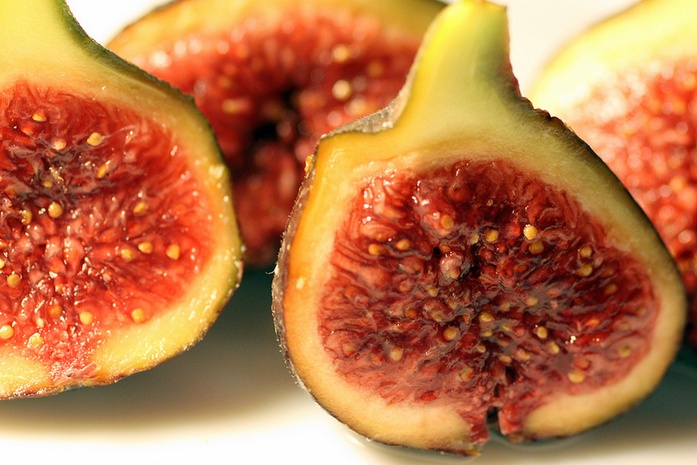
The Fig
In ancient times, as well as today, figs were a prominent, yet inexpensive, food source in Israel. The fruit was used as examples and metaphors to teach us how to live, and the ways of God. Here are a few interesting facts. 

The fig has medicinal qualities, and was used on Hezekiah as a poultice, placed on the boil that had made him ill. In the law concerning the Sabbath, orchards of figs were to be left alone in the seventh year, so they could be eaten by the beasts of the field and gathered for food by the poor. 

Figs are mentioned as part of the “Seven Species” named in Deuteronomy 8:8, where Israel is described as a blessed land. In Proverbs 27:18, there is an analogy made between a person who tends a fig tree is allowed to eat the fruit and a person who cares for his master will be honored, implying that fig trees represent people of prominence and authority in ancient Israeli culture. In Hosea 9:10, the first-ripe fig, in its first season, is used to describe the Hebrew patriarchs. 

In Jeremiah 24, God uses good, edible figs as a metaphor for His people in leadership that obeyed Him, and rotten figs for King Zedekiah, who refused to obey the prophet Jeremiah. Micah, in chapter 7, likens figs to the characteristics of being Godly and upright.


In the Gospels, Yeshua curses a fig tree because it has no fruit. The early fig tree puts out fruit before it puts out leaves, so a fig tree with leaves should have had fruit on it. That tree was symbolic of a person of prominence being “all show” and no substance; e.i., a hypocrite. Yeshua cursed it to the root, because hypocrisy is rooted in evil.


Perhaps the most meaningful symbolism is found in the Hebrew etymology of the word fig.
bikkurah: the first ripe fig, early fig
Original Word: בִּכּוּרָה
Part of Speech: Noun Feminine
Phonetic Spelling: (bik-koo-raw')

from bakar: to bear new fruit, to constitute as first-born
Original Word: בָּכַר
Part of Speech: Verb
Phonetic Spelling: (baw-kar')
from a primitive root word: to burst the womb, i.e. to bear or make early fruit (of woman or tree); to give the birthright, to make firstborn, be firstling, bring forth first child (new fruit).